

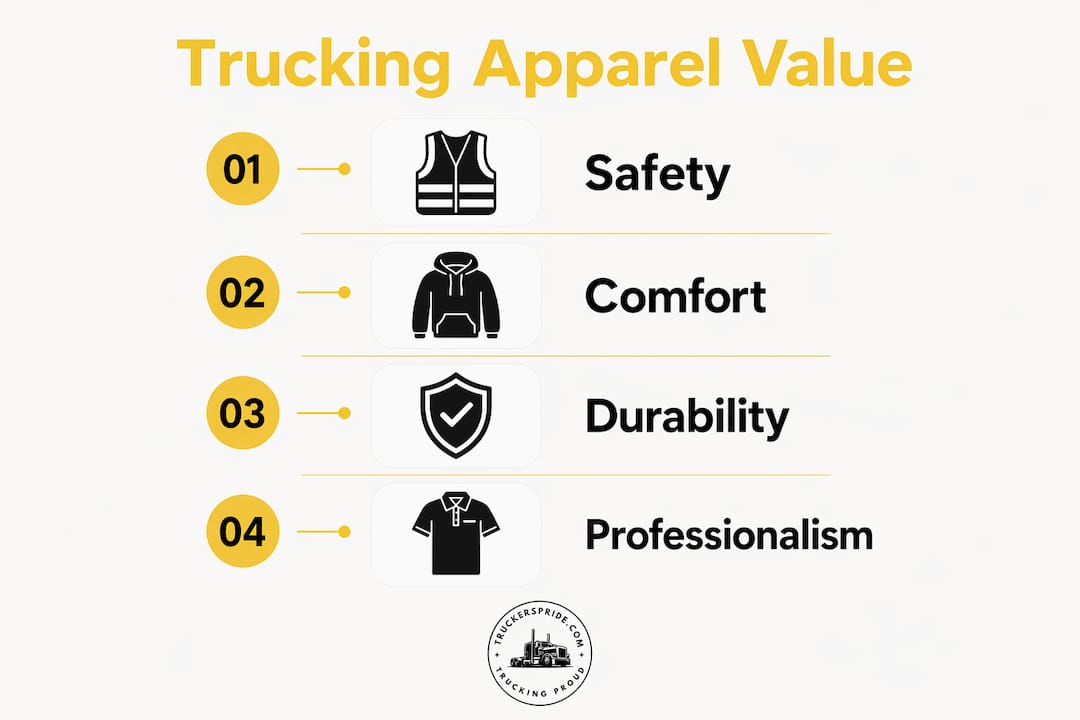
Value in trucking apparel is defined by how well clothing performs across four demands that matter most to professional drivers: safety, comfort, durability, and professional image. Generic workwear fails on all four counts. A driver spending ten or more hours behind the wheel, then stepping out at a loading dock in poor lighting, needs gear that works as hard as they do. Understanding what is value in trucking apparel means looking past the price tag and asking whether the clothing earns its place on every mile of the route.
What is value in trucking apparel, and why does it matter?
Value in trucking workwear is the measure of how much a garment contributes to a driver’s safety, comfort, and professional standing relative to what it costs. That definition matters because the trucking environment is unlike any other workplace. A driver may load freight in freezing temperatures at 4:00 AM, then sit in a heated cab for eight hours, then unload in afternoon heat. No single piece of generic clothing handles that range well.
Transport apparel is a key investment for worker safety, regulatory compliance, and team identity. That framing shifts the conversation from “what does it cost?” to “what does it cost me not to have it?” Drivers who wear the right gear report fewer physical complaints, better focus, and more confidence at every stop.

The importance of trucking apparel also shows up in how others perceive the driver. A clean, well-fitted uniform communicates discipline and reliability before a single word is spoken. That perception has real operational consequences, which the sections below address in detail.
How do safety standards and compliance define apparel value?
Safety is the non-negotiable foundation of any honest assessment of trucking apparel quality. High-visibility clothing that meets EN ISO 20471 is often mandatory or recommended at loading docks, with Class 2 garments typically sufficient for most trucking environments. EN ISO 20471 sets minimum requirements for retroreflective tape coverage and background material color, so a garment either meets the standard or it does not.
The compliance picture is more complicated than the standard itself. 75% of companies report difficulty with consistent PPE use, and comfort and proper fit are the primary drivers of that failure. A vest that bunches under a jacket or restricts arm movement gets left in the cab. That choice creates real risk.
Key safety features that define value in high-visibility trucking apparel include:
- Retroreflective tape placement that remains visible from multiple angles, not just head-on
- Flame-resistant fabric for drivers who work near fuel or hazardous materials
- Lightweight construction that does not add heat or restrict movement during loading tasks
- Secure closures that keep the garment in place during physical work
Poorly fitting high-vis vests cause lower adoption rates. Flexible and lightweight materials increase safety gear use. That finding reframes the fit question: fit is not a comfort preference, it is a safety variable.
Pro Tip: When evaluating a high-visibility garment, put it on and reach across your body as if grabbing a freight strap. If the vest rides up and exposes your torso, the fit is wrong for active work.
Why does fabric technology matter for driver comfort?
Comfort is not a luxury consideration in trucking. Comfortable, well-fitted apparel increases productivity and reduces fatigue for mobile transport workers. That connection between clothing and performance is direct: a driver who is physically uncomfortable shifts focus from the road to the discomfort.
Long-haul driving combines extended sitting with periodic bursts of physical activity at stops. That combination creates specific fabric demands that cotton alone cannot meet. Synthetic moisture-wicking base layers outperform cotton in comfort and dryness on long-haul trips. Cotton absorbs sweat and holds it against the skin. Synthetic fabrics move moisture away from the body and dry faster, which matters enormously over a ten-hour shift.
A practical approach to fabric selection for long-haul drivers follows this logic:
- Base layer: Choose a synthetic moisture-wicking fabric. Polyester blends or performance fabrics keep skin dry during extended sitting and physical loading tasks.
- Mid layer: Select a breathable fleece or lightweight insulating layer that can be removed easily when moving between cold outdoor environments and a heated cab.
- Outer layer: Prioritize wind resistance and water repellency without sacrificing mobility. Stretch panels at the shoulders and elbows allow full range of motion.
- Fit check: Every layer should allow a full arm raise and a forward bend without pulling. Restricted movement signals a fit problem that will compound over hours.
Temperature regulation across layers is where most generic workwear fails. A driver cannot stop to change clothes mid-route, so each layer must function independently and in combination.
Pro Tip: Avoid 100% cotton base layers on long hauls. A polyester-cotton blend of at least 50% synthetic content manages moisture significantly better during extended cab time.
Does durability affect the long-term value of trucking clothing?
Durability is where the cost-per-wear calculation becomes clear. A garment that costs more upfront but lasts three times as long delivers better value than a cheaper option replaced every few months. For drivers, replacement frequency also means time spent shopping and periods without proper gear.
Durable trucking apparel resists stains from oil, grease, and dirt, and maintains visibility and protective features after repeated washing. That last point is critical for high-visibility garments. Retroreflective tape degrades with improper washing, and a garment that no longer meets EN ISO 20471 after twenty washes is not a durable garment regardless of how it looks.
| Durability factor | Why it matters for drivers |
|---|---|
| Stain resistance | Keeps appearance professional without constant replacement |
| Wash-stable reflective tape | Maintains EN ISO 20471 compliance over the garment’s life |
| Reinforced seams | Withstands repeated physical loading and unloading tasks |
| Colorfast fabric | Preserves professional appearance after industrial laundering |
Eco-friendly laundering and recycled polyester are trending in trucking apparel for environmental sustainability. Recycled polyester performs comparably to virgin polyester in durability tests, so choosing it does not require a trade-off in performance. For fleets managing uniform programs, this also reduces the environmental footprint of regular industrial washing cycles.
Durable apparel also protects professional image consistency. A driver who shows up at the same dock every week in gear that holds its shape and color builds a reputation without saying a word.
How does professional appearance add value at every stop?
Professional appearance is the most underestimated dimension of trucking apparel value. The assumption that appearance is superficial misses how much it influences real operational outcomes. Drivers wearing professional, compliant apparel experience faster processing at loading docks. That is not a soft benefit. Time saved at each stop compounds across a route.
Professional image built on well-fitted, clean, durable apparel influences reputation and trust, smoothing interactions at transit points. Dock workers, warehouse managers, and dispatchers form quick judgments. A driver who looks the part gets the benefit of the doubt in ambiguous situations.
The identity dimension of trucking apparel runs deeper than professionalism alone. Trucker shirts with symbols convey identity, professionalism, and pride, reinforcing a cultural brotherhood among drivers. That sense of shared identity is not trivial. The trucking profession carries a stigma in some quarters, and apparel that signals pride and craft pushes back against that perception.
The benefits of trucking clothing that carries professional and cultural weight include:
- Faster dock interactions because appearance signals competence and compliance
- Reduced disputes at transit points where a professional presentation sets a cooperative tone
- Driver morale that comes from wearing gear that reflects the dignity of the work
- Community recognition among fellow drivers who share the same values and road culture
Truckerspride builds apparel around exactly this understanding. The trucking apparel camaraderie that develops among drivers who wear gear made for the profession is real and measurable in how drivers carry themselves at every stop.
Key Takeaways
Value in trucking apparel is determined by how well safety, comfort, durability, and professional image work together to support a driver’s performance and well-being on every shift.
| Point | Details |
|---|---|
| Safety compliance is foundational | EN ISO 20471 Class 2 garments set the minimum standard for loading dock visibility. |
| Fit drives adoption | Poorly fitting high-vis gear gets abandoned; flexible, lightweight designs increase consistent use. |
| Fabric choice affects fatigue | Synthetic moisture-wicking layers outperform cotton for comfort during long-haul shifts. |
| Durability reduces total cost | Wash-stable, stain-resistant apparel maintains compliance and appearance over time. |
| Professional appearance has operational value | Compliant, well-fitted clothing speeds dock processing and builds trust at transit points. |
Why I think the industry undervalues the fit question
After spending years observing how apparel programs succeed and fail in transportation, the pattern is consistent. Companies invest in compliant gear and then wonder why drivers leave it in the cab. The answer is almost always fit. A vest that meets every EN ISO 20471 requirement but restricts movement during a freight check is a vest that will not get worn. Safety gear that does not get worn is not safe gear.
The comfort-versus-safety framing is a false choice. The right fabric and the right cut deliver both. What I have seen work is apparel designed around the actual physical demands of the job, not around a compliance checklist. When drivers are consulted on fit and fabric before a program rolls out, adoption rates improve noticeably. That feedback loop is the most underused tool in fleet management.
Professional image is the other underappreciated asset. A driver who wears gear that reflects the pride of the profession carries that confidence into every interaction. It changes how they are treated at docks, how they handle disputes, and how they feel at the end of a long shift. Apparel is not decoration. For a long-haul driver, it is part of the discipline that makes the job sustainable. Investing in quality gear is one of the clearest ways a driver or a fleet can signal that the work matters. Because it does.
— Sylvain
Gear built for the road, not just the rack
Truckerspride designs apparel around the real demands of long-haul driving, not around what looks good on a product page. Every piece is comfort-tested and road-proven, printed locally in North America for quality control and faster delivery.

The Everyday Essentials Bundle brings together the core pieces a driver needs for comfort, durability, and a professional look across every shift. For drivers who want performance fabric that handles moisture and heat during long cab hours, the DryBlend Performance T-Shirt is built specifically for that demand. Both reflect the same commitment: gear that earns its place on every mile.
FAQ
What makes trucking apparel valuable beyond price?
Value in trucking apparel comes from how well a garment performs across safety compliance, comfort, durability, and professional appearance. A garment that meets EN ISO 20471, fits correctly, and holds up through repeated washing delivers more value than a cheaper option that fails on any one of those measures.
Why does fit matter so much for high-visibility gear?
Poorly fitting high-vis garments get left in the cab, which eliminates their safety benefit entirely. Flexible, lightweight designs that allow full range of motion during loading tasks are the ones drivers actually wear consistently.
How does fabric choice affect a driver’s performance?
Synthetic moisture-wicking fabrics keep drivers drier and more comfortable during long shifts than cotton, which retains sweat against the skin. That difference in comfort directly affects focus and fatigue levels over a ten-hour route.
Does professional appearance have real operational benefits?
Drivers wearing professional, compliant apparel experience faster processing at loading docks and smoother interactions at transit points. Professional presentation reduces friction in dock interactions and builds a reputation for reliability over time.
How do I know if trucking apparel will hold up over time?
Look for wash-stable retroreflective tape, reinforced seams, and stain-resistant fabric. Durable trucking apparel maintains its protective and visibility features after repeated industrial washing, which protects both compliance and professional appearance across the garment’s full life.